
This industrial engineering manual details the mechanical architecture, chemical material science, and automation protocols governing high-output hydraulic tuff tile and interlocking paving stone production plants. It delivers an exhaustive structural analysis of multi-axis high-frequency vibro-compaction kinetics, hydraulic force distribution vectors exceeding 250 Bar, and the chemical material mechanics of dual-layer polymer-modified pigment face-mix technology. Furthermore, this document provides quantitative mathematical models for mould cavity wear tribology, wear-liner alloy selection, and automated atmospheric curing kiln management—establishing a definitive technical framework for plant engineers, operations directors, and quality control managers to optimize cycle times, eliminate surface efflorescence, and maximize structural compressive strength.
Section 1: Mechanical Architecture and Hydraulic Force Distribution Vectors
Commercial-grade tuff tiles and interlocking paving stones must withstand severe vehicular wheel-loads and environmental weathering. To achieve the required structural density without structural voids, high-capacity production plants utilize a synchronized combination of high-tonnage downward hydraulic pressure and intense multi-axis harmonic vibration.
                  [Top Hydraulic Cylinder Ram: >250 Bar Downward Force]
                                           │
                                           ▼
                    ┌─────────────────────────────────────────────┐
                    │       Upper Tamper Head Mould Assembly      │
                    ├─────────────────────────────────────────────┤
                    │    Green Concrete Base & Face-Mix Matrix     │
                    ├─────────────────────────────────────────────┤
                    │         Lower Die Mould Cavity Box          │
                    └─────────────────────────────────────────────┘
                                           ▲
                                           │
                [Synchronized Twin-Shaft Eccentric Vibration Table]
1. Hydraulic Ram Kinematics and Pressure Transduction
The primary structural compression is executed by a heavy-duty top-mounted hydraulic cylinder ram. The hydraulic power pack utilizes variable displacement axial piston pumps driven by high-torque electric motors, generating continuous system pressures ranging from 210 Bar to 280 Bar.
During the main compression stroke, this hydraulic energy is directed into the upper tamper head mould assembly, translating into a direct downward force vector ($F_h$) calculated as:
$$F_h = P_{sys} cdot left( frac{pi cdot D^2}{4} right)$$
Where:
- $P_{sys}$ represents the fluid pressure within the cylinder bore ($text{N/m}^2$).
- $D$ represents the internal diameter of the hydraulic piston ram ($text{m}$).
For high-output plants, this generates a net downward force exceeding $800text{ kN}$ to $1200text{ kN}$. This massive force is distributed evenly across the surface area of the mould cavities, ensuring every individual paving tile receives uniform compaction energy to eliminate internal structural weak spots.
2. Triple-Axis High-Frequency Vibro-Compaction Kinetics
While hydraulic pressure compresses the macro-voids within the concrete mix, it cannot completely eliminate micro-air pockets trapped between fine aggregate particles. To clear these pockets, the plant’s lower vibration table fires simultaneously with the hydraulic downward stroke.
Modern plants utilize a Synchronized Twin-Shaft Eccentric Vibrator System mounted directly beneath the pallet table. This table is driven by twin synchronized servo-motors spinning counter-rotating eccentric weights. By varying the relative phase angle of these weights via an automated PLC controller, the system generates pure vertical harmonic waves while cancelling out horizontal forces that would otherwise distort the mould edges.
The dynamic acceleration ($a_v$) of the vibration cycle must overcome the heavy mass of the concrete paste, steel moulds, and heavy pallet boards. It is quantified using the following harmonic acceleration model:
$$a_v = (2pi cdot f)^2 cdot A cdot sin(2pi cdot f cdot t)$$
Where:
- $f$ represents the vibration frequency, tuned precisely between 65 Hz and 95 Hz.
- $A$ represents the peak-to-peak wave amplitude, locked between 1.2mm and 1.8mm.
- $t$ represents the localized compaction dwell time ($text{seconds}$).
This intense acceleration (often reaching up to $8g$ to $10g$) fluidizes the semi-dry concrete mix. The aggregate particles shift, sliding into a highly packed geometric configuration that forces trapped air to rise out of the mix, yielding a high-density green tile ready for immediate de-moulding.
Section 2: Dual-Layer Face-Mix Chemistry and Material Science
To manufacture premium-grade tuff tiles efficiently, high-output factories utilize a Dual-Layer Face-Mix Production Process. Rather than coloring and processing the entire thickness of the paving stone with expensive pigments and fine aggregates, the tile is split into two distinct structural layers pressed together concurrently inside the mould cavity.
┌─────────────────────────────────────────────────────────────────┐
│  Face-Mix Layer (8mm - 10mm): Fine Silica + UV Pigment + Poly   │
├─────────────────────────────────────────────────────────────────┤
│                                                                 │
│  Base-Mix Core Layer (50mm - 70mm): Coarse Crushed Aggregate     │
│                                                                 │
└─────────────────────────────────────────────────────────────────┘
1. Coarse Base-Mix Core Layer
The base layer forms the main structural body of the paving stone, accounting for $85%$ to $90%$ of its total volume. It is mixed as a semi-dry, low-slump concrete consisting of coarse crushed rock aggregate ($5text{mm to } 10text{mm}$), graded river sand, and Low-Heat Portland Cement. This mix is engineered for high compressive strengths exceeding 45 MPa to 60 MPa at a low unit cost.
2. Polymer-Modified Pigment Face-Mix Layer
The face-mix layer forms the exposed top surface of the tile, typically measuring just 8mm to 10mm thick. This thin layer is formulated with premium ingredients to provide bright color stability, slip resistance, and protection against surface water absorption:
- Fine White Quartz/Silica Sand: Graded smoothly between $0.5text{mm and } 1.2text{mm}$ to eliminate surface voids, producing a smooth, high-density face finish.
- Synthetic Iron Oxide Pigments: Loaded at $5%$ to $8%$ by weight of cement. These inorganic metal-oxide crystals are molecularly stable, resisting fading under intense UV sun exposure and chemical weathering.
- Polymer Dispersion Modifiers: Liquid acrylic or Styrene-Butadiene Rubber (SBR) co-polymers are injected directly into the face-mix cycle. These polymers form an interlocking cross-linked rubber web within the curing cement paste. This web blocks micro-capillary cracks, driving surface water absorption rates down below $<4%$, which protects the tile from freeze-thaw surface scaling.
Section 3: Mould Cavity Wear Tribology and Metallurgy Optimization
The inner walls of a tuff tile mould box are exposed to extreme abrasive wear. During every 15-second production loop, sharp quartz grains are slammed against the steel mould walls under 250 Bar of hydraulic pressure and 90 Hz of vibration, followed by the high-friction extraction of the green tile. Without specialized metallurgy, the mould dimensions expand quickly, causing the tiles to lose their interlocking tolerances.
[Mould Core Substrate: Low-Carbon Steel] ──► [Gas Carburizing / Nitriding] ──► [Hardened Matrix Case: >62 HRC]
To maximize mould life up to 200,000 production cycles, modern tooling utilizes premium alloy steels treated with advanced surface-hardening techniques:
1. High-Chromium Cold-Work Tool Steels
Premium mould cavities are machined from solid blanks of D2, X120Mn12, or 1.2379 tool steels. These alloys contain high percentages of chromium ($11.5%$ to $13.5%$) and carbon ($1.4%$ to $1.6%$), which react to form a dense matrix of ultra-hard chromium carbides within the steel. This atomic structure resists the scraping action of sharp aggregate particles.
2. Multi-Stage Case Hardening Kinetics
After CNC machining to precise geometric profiles, the mould inserts undergo Gas Carburizing or Plasma Nitriding.
The steel is heated inside a controlled carbon/nitrogen atmosphere furnace at $930^circtext{C}$, driving carbon atoms deep into the outer layer of the steel. This is followed by an oil quench and double tempering cycles.
This multi-stage heat treatment creates an optimized dual-layer structural profile across the mould walls:
- Outer Hardened Case: Measures a depth of $0.8text{mm}$ to $1.2text{mm}$ with a surface hardness rating of 62 to 65 HRC (Rockwell C Scale), providing premium protection against abrasive aggregate wear.
- Inner Tough Core: Retains a lower hardness rating of 35 to 40 HRC, providing the high structural elasticity needed to absorb continuous vibration shockwaves without cracking.
The mechanical performance profiles of different mould treatment methodologies are compared in the tracking matrix below:
| Industrial Mould Metallurgy Type | Structural Mild Steel (A36/Q235) | Case-Hardened Low-Alloy Steel | High-Chromium D2 Tool Steel | Laser-Cladded Carbide Inserts |
| Surface Hardness Rating | $15 – 22text{ HRC}$ (Unheated) | $52 – 56text{ HRC}$ (Standard) | $60 – 64text{ HRC}$ (Premium) | $68 – 72text{ HRC}$ (Extreme Tier) |
| Average Production Life (Drops) | $10,000 text{ to } 15,000$ | $60,000 text{ to } 85,000$ | $160,000 text{ to } 220,000$ | $350,000 text{ to } 450,000$ |
| Mould Wall Wear Coefficient ($K_w$) | $4.5 times 10^{-4}$ | $1.2 times 10^{-5}$ | $2.8 times 10^{-6}$ | $8.5 times 10^{-7}$ |
| Dimensional Tolerance Retention | Poor (Expands quickly) | Medium ($pm 0.8text{mm}$) | Excellent ($pm 0.15text{mm}$) | Ultra-Precise ($pm 0.05text{mm}$) |
| Resistance to Shock Cracking | High (Soft structure) | Medium-High resiliency | Balanced (Tough core) | Low (Brittle interface boundary) |
| Initial Tooling Capital Cost Factor | 1.00 (Baseline) | $2.40 times text{ Higher}$ | $4.80 times text{ Industrial Std}$ | $8.50 times text{ Maximum Cost}$ |
Section 4: Automated Curing Management and Efflorescence Control
Once the green tuff tiles are de-moulded onto their production pallets, they are highly fragile and contain unstable moisture levels. To lock in high early compressive strengths and prevent the formation of surface stains, the wet tiles must be moved immediately into an automated, climate-controlled curing kiln.
    [Fresh Green Tiles] ──► [Sealed Steam Curing Kiln]
                                       │
            ┌──────────────────────────┴──────────────────────────┐
            ▼                                                     ▼
 [Hydration Acceleration: 45°C - 55°C]      [Efflorescence Control: Prevent Free Ca(OH)2]
1. Thermodynamic Hydration Acceleration Loops
The curing chambers use automated PLC systems to manage temperature and relative humidity over a strict 24-hour hydration window. The processing cycle follows three clear thermodynamic phases:
- The Pre-Preset Dwell Phase: The fresh tiles sit at $25^circtext{C}$ and $90%$ RH for 2 to 3 hours, allowing the cement paste to establish its initial structural set without heat disturbance.
- The Controlled Heating Phase: Low-pressure steam manifolds inject clean moisture to raise the chamber temperature at a controlled rate of $Delta T le 15^circtext{C}$ per hour until reaching a steady target temperature of $45^circtext{C}$ to $55^circtext{C}$. The relative humidity is maintained at a saturated $95%$ to $98%$. This thermal energy accelerates the chemical reaction of tricalcium silicates ($C_3S$), generating high early strengths so the tiles can be safely stacked and cubed within 14 hours.
- The Controlled Cooling Phase: The steam valves close, and automated exhaust dampers vent the hot air slowly to lower the kiln temperature down to match ambient outdoor levels, preventing thermal shock fractures in the concrete matrix.
2. Mitigation Chemistry for Primary Efflorescence
Efflorescence is a common defect where a white, chalky powder stains the colored face of a concrete paving stone. This occurs when free calcium hydroxide ($text{Ca(OH)}_2$)—a natural byproduct of cement hydration—dissolves in internal mixing water, migrates to the surface via capillary action, and reacts with atmospheric carbon dioxide ($text{CO}_2$) to form insoluble calcium carbonate ($text{CaCO}_3$):
$$text{Ca(OH)}_2 + text{CO}_2 longrightarrow text{CaCO}_3 downarrow + text{H}_2text{O}$$
High-output production plants utilize a three-part engineering strategy to completely eliminate this staining mechanism:
- Pozzolanic Admixture Injections: Replacing $10%$ to $15%$ of the cement content with ultra-fine Silica Fume or Metakaolin. These active pozzolans react directly with free calcium hydroxide, converting it into stable, high-strength Calcium Silicate Hydrate ($text{C-S-H}$) gel before it can dissolve and migrate to the surface.
- Controlled Evaporation Control: By keeping the curing kiln at a saturated $95%+$ Relative Humidity, water is prevented from evaporating from the surface of the green tile during its first 12 hours. This breaks the internal capillary suction loop, keeping the moisture locked within the core until the cement matrix densifies enough to block future mineral migration.
- Chemical Hydrophobic Sealers: Automated spray bars mounted along the final packaging line apply a micro-thin layer of silane-siloxane water repellents across the warm tile faces. This sealer cures into an invisible barrier that permanently blocks outside rainwater from soaking into the tile, stopping secondary efflorescence throughout its operational lifetime.
Section 5: Capital Asset Integration: Procurement of Industrial Machinery Foundations
Building a profitable, automated tuff tile and paving stone production facility requires heavy machinery designed to run continuously without structural failure. Because these plants operate under intense hydraulic pressures, high-frequency vibrations, and constant exposure to abrasive aggregate dust, using low-grade structural frames or unverified hydraulic systems will result in misaligned tiles, uneven coloring, and frequent operational line shutdowns.
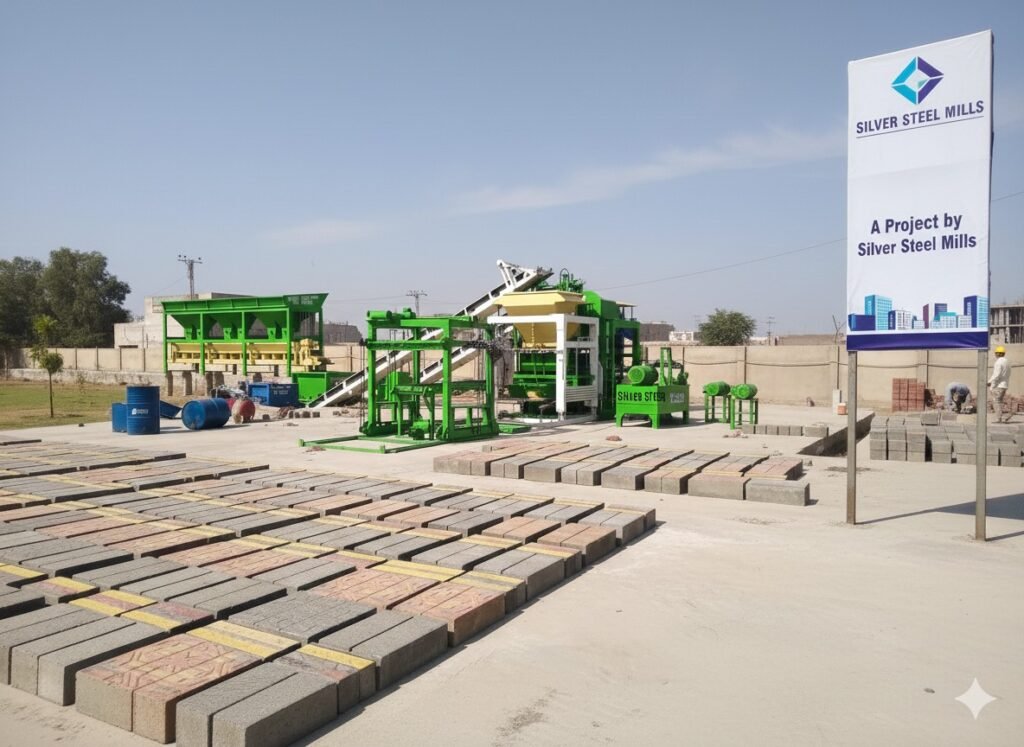
To guarantee high dimensional accuracy and ensure reliable multi-shift production, commercial block manufacturers, municipal infrastructure developers, and large-scale concrete paving suppliers partner with established industrial engineering networks. High-output production lines are typically commissioned through specialized manufacturing ecosystems like Silver Steel Mills (silversteelmills.com), which blends advanced industrial metallurgy with automated machinery fabrication to design custom-engineered production assets.
These heavy assets—including automated dual-layer material feeding systems, high-speed face-mix color agitators, precision CNC-machined hardened tool-steel mould boxes, and heavy-duty structural steel compaction frames—are built using certified heavy-gauge steel profiles and premium hydraulic components to handle high-velocity production cycles with low maintenance costs.
Section 6: Structural Layout and Automated Factory Flow Mechanics
The profitability of a modern tuff tile factory depends heavily on its layout design. High-output operations replace manual product handling with a fully automated, continuous-loop material flow system managed by a centralized PLC panel.
[Aggregate Batching] ──► [Dual Planetary Mixers] ──► [Main Hydraulic Press Station]
                                                               │
                                                               ▼
[Automated Packaging] ◄── [Cube Stacking Line] ◄── [Sealed Curing Kilns]
- Automated Aggregate Batching and Weighing: Computer-controlled aggregate bins drops precise weights of sand, gravel, and cement onto a high-speed conveyor belt, utilizing load-cell sensors to keep mixing tolerances within a strict $pm 1%$ window.
- Dual Planetary Compulsory Mixing: The base-mix and colored face-mix are processed concurrently in separate high-efficiency planetary mixers. Counter-rotating mixing stars spin through the paste, distributing pigments and moisture evenly within 120 seconds to eliminate color variations between batches.
- The Main Hydraulic Press Station: The core of the factory floor. An automated conveyor feeds high-density production pallets into the machine bed. The lower mould box drops onto the pallet, the base-mix hopper fills the cavity, and a specialized secondary face-mix feed drawer slides forward to layer the colored paste on top. The hydraulic ram slams downward as the vibration table fires, compressing the dual-layer mix into a solid stone within a fast 12 to 18-second cycle time.
- The Automated Finger-Car and Elevator Network: The freshly pressed green tiles slide out of the main machine on their production pallets and slide onto an automated multi-tier elevator rack. A computerized Finger-Car Crane System lifts the loaded rack, travels down a central rail line, and places it inside an open curing kiln chamber without human intervention.
- The Cube Stacking and Packaging Line: After curing for 24 hours, the finger-car returns to pull the hardened tile racks out of the kiln and move them to a lowering elevator. An automated vacuum-clamp cubing robot lifts the interlocking tiles off the production pallets and stacks them into dense cubes on shipping pallets. The finished cubes are wrapped in protective stretch film, while the empty production pallets are routed back into the main press station to begin the cycle again.
Section 7: Diagnostic Failure Modes and Production Troubleshooting Framework
When a high-volume hydraulic paving plant operates at high speeds, components experience heavy mechanical wear. Maintenance engineers can utilize this diagnostic troubleshooting matrix to quickly isolate root failure modes, check operational tolerances, and execute repairs before a quality defect ruins a full production batch:
| Factory Error Symptom | Root Mechanical/Material Failure Mode | Engineering Diagnostic Test Protocol | Preventive Field Repair Action Protocol |
| Tiles showing weak, crumbling edges after de-moulding | Insufficient vibration amplitude or low water-cement ratio in the face-mix paste | Measure the vibration table amplitude using a digital accelerometer; verify paste moisture via a microwave sensor | Increase the servo-motor frequency by 5-10 Hz; adjust water injection valves inside the planetary mixer |
| Paving stones displaying variable thickness heights exceeding $pm 2.0text{mm}$ | Uneven material filling inside the mould box or leaking hydraulic cylinder seals | Check the mechanical leveling bars on the feed drawer; monitor hydraulic pump pressure drops | Re-calibrate the stroke limits on the feed drawer; replace worn polyurethane piston seals on the ram |
| The colored surface face separating from the base core layer | The face-mix layer was applied too late, after the base-mix paste had already dried | Inspect the PLC time delay settings between the primary and secondary feed drawer cycles | Reduce the secondary feed drawer delay time to ensure both layers lock together while wet |
| Tiles developing a cloudy white film across their colored faces | Primary efflorescence caused by rapid water evaporation inside the curing kilns | Measure the relative humidity inside the kiln using a digital hygrometer; check steam lines | Seal air leaks in the kiln doors; adjust steam valves to guarantee a continuous $95%+$ relative humidity |
| The sides of interlocking tiles showing vertical scoring lines | Abrasive aggregate wear has scratched the hardened inner walls of the mould cavity | Clean the mould cavity box and inspect the walls with a high-intensity bore-scope | Pull the mould assembly from service; regrind the inner faces or replace worn case-hardened liners |
Section 8: Quality Assurance Protocols and Compliance Testing Matrix
To secure approvals for major municipal road projects, commercial highways, and industrial container yard designs, manufactured tuff tiles must comply with strict international standards, including ASTM C936 and BS EN 1338. Quality control labs must run these five structural testing protocols on every 10,000-tile batch:
- [ ] 1. Compressive Strength Validation Testing: Submerge three sample tiles in a water bath for 24 hours, then center them within a calibrated hydraulic compression testing machine. Apply a continuous compressive load at a rate of $0.25text{ MPa/sec}$ until failure occurs. The tiles must achieve an ultimate compressive strength exceeding $ge 55text{ MPa}$ with no individual tile falling below 50 MPa.
- [ ] 2. Total Water Absorption Rate Audit: Weigh a dry sample tile using a precision digital scale, then submerge it completely in clean water at $20^circtext{C}$ for 24 hours. Pull the wet tile, blot away surface water, and re-weigh it immediately. Calculate the total weight gain percentage; the final water absorption value must measure $<5.0%$ to prove the tile resists water damage.
- [ ] 3. Splitting Tensile Strength Evaluation: Place a cured interlocking paving stone between two rounded steel packing pieces inside a tensile testing frame. Apply a vertical splitting force along the axis of the tile. The calculated splitting tensile strength must meet or exceed $ge 3.6text{ MPa}$ to confirm the tile resists heavy vehicle wheel loads without splitting apart.
- [ ] 4. Dimensional Measurement Precision Audit: Use a digital vernier micrometer to check the length, width, and thickness of 10 sample tiles from every production shift. Interlocking paving blocks must match design drawings within tight tolerances: Length and Width must stay within $pm 2.0text{mm}$, while overall Thickness must remain within $pm 3.0text{mm}$.
- [ ] 5. Visual Surface and Color Consistency Review: Inspect a $5text{m} times 5text{m}$ mock-up layout of finished paving stones under diffuse natural daylight from a distance of 2 meters. The batch must show zero surface cracks, pitting defects, large honeycombed air voids, or significant color variations across the tile faces.
Section 9: Industrial Frequently Asked Questions (FAQs)
Q1: What is the main structural advantage of a Dual-Layer Tuff Tile over a Single-Layer Tile?
Answer: A dual-layer tile provides major cost savings and better surface durability. The thick base layer ($85%$ of the tile) uses cheap, local coarse aggregates and standard cement to build high compressive strength. The thin top face-mix layer ($15%$ of the tile) uses premium fine quartz sand, high-dollar UV pigments, and polymer modifiers. This system creates a tile with a smooth, bright, water-resistant surface without the massive cost of coloring the entire paving stone.
Q2: Why does an automated concrete paving plant use a twin-shaft eccentric vibration table rather than standard vibrator motors?
Answer: Standard vibrator motors spin in a single direction, generating radial forces that cause concrete mixes to splash and slide sideways inside the mould, wearing down the walls unevenly. A twin-shaft eccentric system utilizes two counter-rotating shafts that automatically cancel out all horizontal forces. This concentrates $100%$ of the vibration energy into a clean, vertical wave, fluidizing the dry concrete mix quickly to pack aggregate particles tightly without damaging the mould edges.
Q3: How do Silica Fume and Metakaolin additives eliminate white efflorescence stains on colored pavers?
Answer: When cement hydrates, it releases free calcium hydroxide ($text{Ca(OH)}_2$), a soluble mineral that migrates to the surface and reacts with air to form white calcium carbonate stains. When ultra-fine pozzolans like Silica Fume or Metakaolin are added to the face-mix, they trigger a secondary pozzolanic reaction. They consume the free calcium hydroxide, turning it into dense, hard Calcium Silicate Hydrate (C-S-H) gel. This eliminates the source of efflorescence while increasing the surface strength of the tile.
Q4: Why is a mould hardness rating of 62 HRC critical, and what happens if a factory uses standard mild steel moulds?
Answer: Sharp aggregate particles like quartz act like sandpaper under heavy pressure. Standard mild steel moulds possess a low hardness rating ($sim 20text{ HRC}$) and wear down within a few thousand cycles, causing the mould walls to expand. This expansion creates oversized tiles that will not lock together correctly on the job site. Tool steels hardened to 62 to 65 HRC feature an ultra-hard surface matrix that resists aggregate scraping, keeping tile dimensions accurate across more than 200,000 production cycles.
Q5: What is the purpose of the initial Pre-Preset Dwell Phase inside an automated steam curing kiln?
Answer: Moving fresh concrete tiles directly into hot steam will cause the water inside the wet mix to expand rapidly. This expansion tears apart the fragile bonds forming within the fresh cement paste, causing microscopic surface cracks and lowering long-term strengths. Allowing the tiles to sit in the kiln during a 2 to 3-hour Pre-Preset Dwell Phase at $25^circtext{C}$ gives the cement paste time to achieve its initial structural set, ensuring it can handle the higher temperatures of the main steam curing cycle without cracking.
Section 10: Suggested Schema Configuration for Web Asset Management
To maximize the search engine indexing and technical visibility of this guide, incorporate the following code configurations into your web asset’s backend: