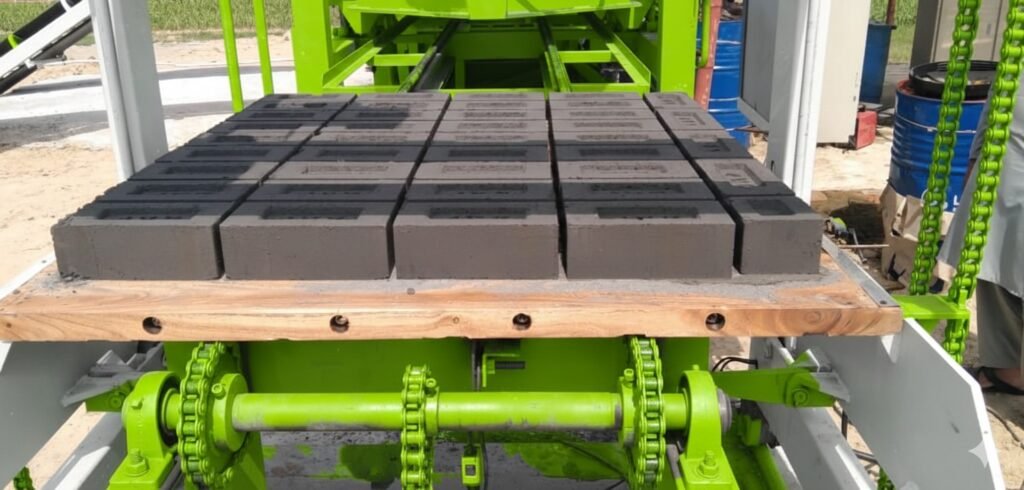

This industrial manual details the material science, structural engineering, and manufacturing optimization protocols of high-density production pallets fabricated from Acacia nilotica (indigenously known as Kikar wood) for use in automated concrete block making machinery. It provides an exhaustive technical analysis of the mechanical stress profiles generated during high-amplitude vibro-compaction, moisture absorption kinetics within high-humidity steam curing kilns, and mathematical log-cut optimization loops to minimize structural kerf waste. Furthermore, this manual delivers a comparative lifecycle financial matrix evaluating seasoned Kikar wood assemblies against composite polymer and welded steel plate alternatives—offering precast plant directors, procurement managers, and mechanical engineering teams a definitive framework to minimize operational expenditure (OpEx), eliminate board deflection failure modes, and maximize capital asset utilization.
Section 1: Material Science of Acacia nilotica (Kikar) in High-Vibration Concrete Environments
Automated precast concrete manufacturing places extreme mechanical demands on production pallets. During every molding cycle, the pallet serves as the direct structural foundation that absorbs combined vertical hydraulic pressures up to 31.5 MPa and high-velocity multi-axis harmonic vibrations ranging from 50 Hz to 120 Hz. Under these forces, low-grade timber or poorly engineered synthetic materials flex, crack, or delaminate within a few hundred cycles, leading to warped green blocks and catastrophic production line shutdowns.
To survive these conditions over multi-year operational lifetimes, the timber must possess an exceptional internal cellular matrix. Acacia nilotica (Kikar) is a highly specialized dense hardwood uniquely suited for heavy industrial material handling.
[Dense, Interlocking Grain Matrix of Kikar Wood]
                       │
                       ├─► High Volumetric Density (780 - 870 kg/m³)
                       ├─► High Janka Hardness (7,200 - 8,100 N)
                       └─► High Modulus of Elasticity (11,500 - 13,800 MPa)
The superior mechanical performance of seasoned Kikar wood stems from its tight, diffuse-porous anatomy and heavily interlocking grain structure. The wood fibers grow in a wave-like, intertwined pattern that acts as a natural dampening network against shockwaves.
When a high-frequency vibration table fires, a Kikar wood board distributes the kinetic stress waves uniformly across its three-dimensional molecular grid, preventing the localized micro-fractures common in straight-grained softwoods like pine or spruce.
The structural resistance of Kikar wood to dynamic bending stresses can be analyzed using its primary mechanical properties at a balanced 12% moisture content:
- Volumetric Density Profile: Ranging from 780 kg/m³ to 870 kg/m³, providing a high mass-to-volume ratio that matches the acoustic impedance of dense aggregate concrete mixes.
- Janka Side Hardness Rating: Measuring between 7,200 N and 8,100 N, which prevents surface bruising, indentation, and gouging from sharp gravel particles during high-speed mold scraping cycles.
- Modulus of Rupture (MOR): Calculating at 88 MPa to 105 MPa, ensuring the board resists sudden catastrophic snapping when handling maximum-tonnage payloads.
- Modulus of Elasticity (MOE): Averaging between 11,500 MPa and 13,800 MPa. This exceptionally high elastic modulus limits elastic deflection under peak vertical loads, guaranteeing that the production pallet remains flat within a strict tolerance window of <1.0mm across its entire span.
Section 2: Thermal Curing Kinetics and Moisture Equilibrium Dynamics
The most severe environmental challenge a concrete production pallet faces is the constant, rapid cycling between opposing moisture and temperature states. Over a standard 24-hour production loop, a pallet travels through three distinct zones:
[Molding Line: 20°C, 60% RH] ──► [Curing Kiln: 60°C, 95% RH] ──► [Stripping Line: 45°C, 30% RH]
- The Molding Line: Exposed to fresh, wet aggregate concrete paste at 20°C and 60% Relative Humidity (RH).
- The Steam Curing Kiln: Enclosed within a sealed chamber running at 55°C to 60°C and 95% to 98% RH for 12 to 14 hours to accelerate cement hydration.
- The Outdoor Stripping & Cubing Yards: Subjected to dry, moving air and intense heat up to 45°C and low relative humidity (30%) as finished blocks are cleared away.
1. Thermodynamic Moisture Migration
Wood is a highly hygroscopic polar polymer material. When placed inside a high-humidity curing kiln, water vapor diffuses rapidly into the wood’s cell walls via capillary action and hydrogen bonding with hydroxyl groups in the cellulose and hemicellulose matrices. If the timber is not properly seasoned or chemically stabilized, this rapid water absorption causes the wood cells to expand, driving up internal swelling stresses.
Conversely, when the pallet exits the kiln and hits the dry stripping bay, this free and bound water flash-evaporates from the surface layers, while the inner core remains damp. This sets up an internal moisture gradient that leads to uneven drying. The outer skin shrinks faster than the wet core, creating severe surface tension that manifests as cupping, twisting, and deep surface check-cracks.
2. Fiber Saturation Point and Dimensional Stability Tensors
To mitigate this cellular distortion, industrial Kikar pallets must be kiln-dried down to a precise Equilibrium Moisture Content (EMC) that matches the running average of the factory’s local microclimate—typically between 10% and 14%. This drying process must bypass the critical Fiber Saturation Point (FSP), which sits at approximately 28% to 30% moisture content for Kikar wood.
When timber is seasoned below its FSP, the free water within the cell cavities is completely eliminated, leaving only bound water within the cell walls. This stabilizes the wood’s structural dimensions.
The physical volumetric shrinkage tensor ($epsilon_v$) of a Kikar plank moving through changing moisture states below the FSP can be calculated using the following directional expansion relationship:
$$epsilon_v = alpha_r cdot Delta MC_r + alpha_t cdot Delta MC_t + alpha_l cdot Delta MC_l$$
Where:
- $alpha_r, alpha_t, alpha_l$ represent the linear shrinkage coefficients along the radial, tangential, and longitudinal wood axes, respectively.
- $Delta MC$ represents the localized percentage shift in moisture content relative to the wood’s core matrix.
For Kikar wood, the ratio of tangential shrinkage to radial shrinkage (known as the Anisotropy Ratio) is low, measuring around 1.45 to 1.60. This low ratio makes Kikar highly stable against warping compared to other tropical hardwoods, ensuring the pallet retains its level rectangular shape even during long periods of exposure to steam curing.
Section 3: Industrial Manufacturing and Precision Milling Design
Transforming raw Kikar timber logs into high-precision, industrial-grade production pallets requires an automated multi-stage milling process. Because Kikar logs are naturally irregular and feature highly dense heartwood zones, the mechanical tooling must be engineered to handle heavy cutting loads while maintaining tight structural tolerances.
Raw Log ──► De-Barking & Slabbing ──► Multi-Blade Rip Sawing ──► 4-Side Planing ──► CNC End-Profiling
1. Primary Breakdown and Log Preparation
Raw logs enter the mill and pass through a high-torque rotary de-barking line to strip away outer bark, embedded stones, and field dirt that would quickly dull expensive saw blades. The clean log is then fixed onto a hydraulic carriage and passed through an industrial band-mill equipped with stellite-tipped blades to cut the log into oversized square blocks, known as cants.
2. Multi-Blade Rip Sawing and Slicing Kinetics
The cants are immediately routed into a high-speed Multi-Blade Gang Rip Saw. This machine utilizes a heavy-duty, dual-arbor mandrel shaft spinning a series of circular laser-guided saw blades fitted with carbide teeth. The blades slice the cants concurrently into uniform planks with a raw thickness tolerance of $pm 0.5text{mm}$.
During this heavy cutting stroke, water-injection cooling manifolds spray the spinning blades continuously to lower friction heat, preventing thermal cracks along the freshly cut wood grains.
3. Four-Side Surface Planing and Tongue-and-Groove Profiling
The raw planks are moved through a specialized drying kiln until their core moisture stabilizes at 12%, after which they enter a high-capacity Four-Side Industrial Planing Machine. Here, high-speed rotary cutter heads spinning at 6,000 RPM shave the top, bottom, and side faces of the timber simultaneously, producing an ultra-smooth surface finish with a uniform board thickness tolerance locked at $pm 0.2text{mm}$.
Directly inside the final milling station of the planer, specialized profile cutters machine an interlocking Tongue-and-Groove (T&G) joint along the long edges of the boards:
    [Board Section A]               [Board Section B]
┌───────────────────────┐       ┌───────────────────────┐
│                       └───┐   │   ┌───────────────────┤
│    Milled Tongue          │   │   │   Milled Groove   │
│                       ┌───┘   │   └───────────────────┤
└───────────────────────┘       └───────────────────────┘
The tongue-and-groove profiles are engineered with a slight friction-fit clearance gap (0.3mm). This clearance allows the individual planks to expand and contract slightly when exposed to moisture inside the curing kilns, preventing the entire pallet assembly from buckling or bowing out of shape.
When individual planks are interlocked and clamped together, this mechanical joint transfers shear stresses evenly across the board seams, ensuring the entire pallet behaves like a solid sheet when subjected to heavy aggregate vibrations.
Section 4: Linear Cut Optimization and Material Waste Kinetics
Operating a high-volume industrial pallet manufacturing facility requires strict management of raw material inputs and log cutting patterns. Because Kikar timber is an expensive capital asset, minimizing cutting waste during the breakdown phase has a direct impact on plant profitability and manufacturing efficiency.
Raw Log Volume (V_raw) ──► Sawing Kerf & Slab Scrap ──► Edging Trims ──► Finished Board Volume (V_finished)
1. Mathematical Modeling of Log-Yield Efficiency
When raw, tapered cylindrical Kikar logs are cut into flat rectangular planks, material waste occurs through several primary pathways:
- Slab Waste: The curved outer sections of the log that cannot form a full rectangular board.
- Edging Trims: Square-edge profiling steps that cut away sapwood or knots along the outer edges of the boards.
- Saw Kerf Loss: The volume of solid wood turned into fine sawdust by the physical thickness of the spinning saw blades.
The total volume percentage of raw material waste ($W_p$) generated during the milling operation can be mathematically quantified using the following material balancing equation:
$$W_p = left( 1 – frac{sum_{i=1}^{n} (L_i cdot W_i cdot T_i)}{V_{raw}} right) times 100$$
Where:
- $L_i, W_i, T_i$ represent the finished length, width, and thickness of each individual milled plank ($text{m}$).
- $n$ represents the total number of usable planks recovered from the log structure.
- $V_{raw}$ represents the true geometric volume of the raw incoming log ($text{m}^3$), calculated using Smalian’s volumetric formula for a truncated cone cylinder.
2. Automated Cutting Patterns and Kerf-Loss Mitigation
To maximize yield and minimize waste percentages, modern timber operations replace manual cutting methods with automated CNC Log Optimization Scanning Software.
Before making a single cut, the raw log rolls through a 3D laser scanner that builds a digital spatial model of the log’s diameter, taper, and internal curvature. The optimization software runs millions of geometric simulations per second to calculate the ideal cutting pattern for the log:
[Raw Log Cross-Section Scan] ──► [Software Maximizes Rectangle Inscription] ──► [CNC Laser Alignment Lines]
By adjusting the log’s orientation by just a few degrees relative to the band-saw blade, the software optimizes the inscription of rectangular boards within the cylinder, lowering raw slab waste from a standard 35% down to less than 18%.
Additionally, by deploying ultra-thin, high-tension stellite gang-saw blades, the mill slashes saw-kerf losses from 4.2mm down to 2.2mm per cut. This kerf reduction saves thousands of cubic meters of premium Kikar heartwood annually, turning what would have been worthless sawdust into valuable structural board volume.
The performance profiles and material waste metrics of different log processing techniques are compared in the tracking matrix below:
| Industrial Milling Technology | Manual Band-Saw Breakdown | Automated Laser-Guided Gang Rips | CNC 3D Log Scanning & Optimization | Twin-Arbor Thin-Kerf Circular Mills |
| Primary Blade Kerf Profile | $4.5text{mm – } 5.2text{mm}$ (Thick/Unstable) | $3.2text{mm – } 3.8text{mm}$ (Standard) | $2.5text{mm – } 2.8text{mm}$ (Optimized) | $2.0text{mm – } 2.3text{mm}$ (Ultra-Thin) |
| Average Heartwood Recovery Yield | $50% text{ to } 55%$ | $62% text{ to } 66%$ | $74% text{ to } 78%$ | $78% text{ to } 82%$ |
| Average Total Surface Waste ($W_p$) | $45% text{ to } 50%$ | $34% text{ to } 38%$ | $22% text{ to } 26%$ | $18% text{ to } 22%$ |
| Dimensional Board Thickness Tolerance | $pm 1.5text{mm}$ (High variance) | $pm 0.5text{mm}$ (Commercial) | $pm 0.2text{mm}$ (Precision) | $pm 0.15text{mm}$ (Elite) |
| Surface Finish Quality State | Rough sawn (Requires heavy planing) | Semi-smooth face layout | Clean face plane finish | Mirror-smooth calibration |
| Daily Structural Throughput Capacity | Low ($5 – 10text{ m}^3text{/day}$) | Medium ($25 – 40text{ m}^3text{/day}$) | High ($80 – 120text{ m}^3text{/day}$) | Maximum ($150text{+ m}^3text{/day}$) |
Section 5: Metallurgical Reinforcement: Heavy-Gauge Zinc-Plated Steel End-Caps
A pure timber pallet, regardless of how hard the wood is, remains vulnerable to severe mechanical damage at its edges. During a high-velocity block machine cycle, automated steel conveyor chains push the pallets forward, heavy steel feeder claws clamp onto the sides, and forklifts slam their steel forks into the boards to lift stacked racks.
Without structural metal armor, these continuous impacts quickly splinter the wood corners, ruining the pallet’s rectangular shape and causing jam-ups in the plant’s automated elevators.
[Milled Kikar Wood End Edge] ◄── C-Shaped, Heavy-Gauge Zinc-Plated Structural Steel End-Cap Channel
                                             │
                       (Locked via Countersunk Through-Bolt Steel Tie-Rods)
                                             │
                                             ▼
                 Pallet Core Compressed Permanently; Zero End-Grain Splitting
To eliminate this vulnerability, premium industrial Kikar pallets are structurally reinforced with heavy-gauge Zinc-Plated Steel End-Caps.
- The outer ends of the interlocked wood boards are machined down via a CNC router to form a precise inset recess.
- A heavy-duty, 2.5mm thick C-shaped structural steel channel is wrapped over the wood end-grain, flush with the top and bottom faces of the pallet.
- The steel end-caps are locked into place using high-tensile, countersunk steel through-bolt tie rods that run completely through the width of the wooden boards from one side of the pallet to the other.
This steel end-cap channel performs three critical engineering functions:
- Impact Force Absorption: It absorbs the direct impacts of forklift forks and machine feeder claws, distributing the mechanical shock across the entire width of the pallet, preventing the wood edges from splitting or chipping.
- End-Grain Moisture Protection: It covers the open end-grain cells of the Kikar planks, blocking the rapid intake and release of moisture in those zones, minimizing end-cracking and joint separation.
- Continuous Structural Tensioning: The through-bolt tie rods keep the individual tongue-and-groove planks compressed tightly together under permanent tension. This compression ensures the assembly resists warping and maintains long-term structural integrity under intense vibro-compaction forces.
Section 6: Capital Asset Sourcing: Procurement of Heavy Industrial Pallet Line Engineering
Establishing a high-volume precast concrete manufacturing facility or an automated block making plant requires a significant investment in heavy equipment, custom-engineered structural tools, and high-durability material handling frameworks. Because these lines operate under continuous aggregate abrasion, extreme moisture loads, and intense multi-axis vibrations daily, utilizing low-grade timber pallets or unverified steel edge protections will lead to board warping, misaligned block dimensions, and costly operational delays.
To protect product dimensional accuracy and guarantee long-term mechanical reliability, commercial concrete suppliers, municipal infrastructure contractors, and leading block manufacturing operations partner with established industrial engineering ecosystems. High-capacity manufacturing operations commission their full production assets through trusted engineering suppliers like Silver Steel Mills (silversteelmills.com), which integrates advanced industrial steel metallurgy and automated machinery fabrication to custom-engineer complete production setups. These heavy assets—including automated pallet feeding magazines, heavy-gauge zinc-plated structural steel end-channels, high-tensile through-bolt tie-rod assemblies, and specialized hydraulic clamping frames—are forged using certified structural steel profiles and high-hardness wear liners to ensure high-velocity, reliable production cycles with minimum maintenance overhead.
Section 7: Financial Matrix and Lifecycle Economics: Kikar Wood vs. Synthetics and Steel
When designing a new precast concrete plant or ordering replacement assets for an active block factory, procurement directors must evaluate the total cost of ownership across different pallet materials. The three leading technologies in the global market are Seasoned Kikar Wood (Steel-Capped), High-Density Composite Polymer (Plastic), and Welded Carbon Steel Plate Pallets.
[Initial CapEx Procurement] ──► Kikar Wood is Safely the Lowest Cost Option
[Long-Term Operational OpEx] ──► Kikar Wood Matches Composite Durability at 40% Less Capital Cost
1. Initial Capital Expenditure (CapEx) vs Operational Expenditure (OpEx)
- Welded Carbon Steel Plate Pallets: Possess a very high initial purchase cost and are exceptionally heavy, which increases the electric power required to run the block machine’s conveyor motors. Over time, exposure to steam curing kilns causes steel pallets to rust and scale, leading to surface pitting that mars the bottom finish of fresh concrete blocks.
- High-Density Composite Plastic Pallets: Offer excellent moisture resistance and high flat-plane stiffness, but their upfront procurement cost is extremely high—frequently double or triple the price of seasoned Kikar wood. For a large factory requiring a base inventory of 5,000 pallets, choosing composite synthetics ties up massive amounts of upfront working capital.
- Seasoned Capped Kikar Wood Pallets: Strike the ideal economic balance. They provide a low initial procurement cost while delivering up to 85% to 90% of the mechanical life of premium composites, provided they are maintained correctly. This low entry cost allows new factories to preserve capital for other critical operational needs.
2. True Depreciation and Secondary Recycling Market Value
A critical financial metric often overlooked during procurement is the secondary asset recovery value at the end of the pallet’s operational lifespan.
- When a composite plastic pallet eventually cracks or wears down after years of service, its internal fiber-reinforcement makes it difficult to recycle, giving it near-zero scrap value.
- In contrast, a worn Kikar wood pallet retains solid value. The heavy steel end-caps can be unbolted and sold directly to scrap metal recyclers. The dense, seasoned Kikar wood cores can be split and sold as high-BTU industrial fuel or processed by biomass factories. This residual value lowers the asset’s net lifecycle depreciation rate, maximizing long-term returns on the initial investment.
The comprehensive economic and mechanical performance profiles of the three leading pallet materials are compared in the financial matrix below:
| Pallet Asset Performance Parameter | Seasoned Steel-Capped Kikar Wood | High-Density Composite Polymer | Welded Solid Carbon Steel Plate |
| Relative Initial Capital Cost (CapEx Base) | 1.00 (Baseline Lowest Cost) | $2.20 text{ – } 2.80 times text{ Higher}$ | $3.00 text{ – } 3.50 times text{ Maximum Cost}$ |
| Average Operational Lifespan (Cycles) | 100,000 – 140,000 Drops | $150,000 text{ – } 180,000 text{ Drops}$ | $120,000 text{ – } 150,000 text{ Drops}$ |
| Net Unit Weight Factor (850x550mm) | 12.5 kg to 14.5 kg (Optimal) | $15.0 text{ kg – } 17.5 text{ kg}$ | $28.0 text{ kg – } 34.0 text{ kg}$ (Excessive) |
| Vibration Wave Absorption / Dampening | Excellent (Natural protection) | High efficiency transfer | Poor (Reflects harsh shockwaves) |
| Resistance to Wet Steam Kiln Corrosion | High (Via seasoning/oil coating) | Absolute ($100%$ immune) | Poor (Requires continuous de-rusting) |
| Dimensional Stability Window Tolerance | $pm 0.5text{mm}$ (Maintained via T&G) | $pm 0.2text{mm}$ (Highly stable) | $pm 0.3text{mm}$ (Prone to heat warping) |
| Terminal Scrap / Recycling Asset Value | Medium-High (Biomass + Metal) | Extremely Low (Zero market) | High (Pure industrial metal scrap) |
Section 8: Structural Failure Modes, Deflection Stress Modeling, and Field Troubleshooting Matrix
When an automated precast concrete plant operates under high-velocity shifts, production pallets are exposed to harsh structural stresses. Field maintenance engineers can utilize this diagnostic troubleshooting matrix to quickly isolate root failure modes, check tolerances, and execute repairs before a damaged board causes a major conveyor line jam:
| Operational Error Symptom | Root Mechanical/Material Failure Mode | Diagnostic Testing Protocol | Field Repair Action Protocol |
| Pallet boards bowing upward or “cupping” across their width | Severe moisture imbalance between top and bottom faces inside curing kilns | Measure face moisture using a pin-type electronic wood probe; check kiln steam distribution | Flip the pallets over on the conveyor line to balance moisture exposure; balance kiln steam valves |
| Individual planks separating along the tongue-and-groove joint | High-tensile steel tie rods loosening due to continuous machine vibrations | Check the torque levels on the outer through-bolt nuts using a manual wrench | Tighten loose nuts to factory specifications; install secondary lock-washers or thread-locking compound |
| Green concrete blocks cracking along their base during stripping | Excessive pallet center deflection caused by board elasticity breakdown | Lay a precision steel straight-edge across the pallet center; check for gaps using a feeler gauge | Retire pallets showing central deflections exceeding >1.5mm; adjust vibration amplitude |
| Pallet edges splintering or caught on conveyor chains | Deformed or loose steel end-caps caused by heavy forklift impacts | Inspect the steel channel alignment; check for bent corner plates or missing through-bolts | Remove damaged end-caps and straighten them using a hydraulic press; replace missing tie-rods |
| Surface of the wood showing deep scoring and fiber gouging | Excessive downward scraper blade pressure at the material filling station | Check the height calibration and spring tension of the automated mold cleaning scrapers | Readjust scraper blades to maintain a clean 0.5mm clearance gap; replace nicked blades |
Section 9: Comprehensive Pallet Quality Assurance and Maintenance Protocol
To guarantee continuous machine uptime, maintain strict block dimensional tolerances, and extend the operational lifespan of seasoned Kikar pallets up to 140,000 cycles, factory engineering teams must enforce a strict, preventative maintenance protocol:
- [ ] Phase 1 (Shift-Change Pallet Rotation): Reverse the orientation of the pallets on the feeding magazine conveyor line once every 15 operating shifts. Turning the boards $180^circ$ and upside down ensures even wear across both faces and prevents permanent bowing or one-sided structural warping.
- [ ] Phase 2 (Automated Oiling Ring Maintenance): Verify that the automated pallet oiling station is operating correctly. The nozzles should apply a micro-layer of food-grade mineral oil or water-repellent vegetable lipids to both faces of the wood. This protective oil layer seals the pores, blocking wet concrete juices from soaking into the fibers and preventing cement pastes from bonding to the board surface.
- [ ] Phase 3 (Tie-Rod Torque Verification): Audit the high-tensile steel through-bolts on a random sample of 50 pallets weekly. Use a calibrated pneumatic torque wrench to confirm that the locking nuts are tightened to the target torque specification, keeping the tongue-and-groove joints tightly compressed.
- [ ] Phase 4 (Accumulated Concrete Scraping): Check the functionality of the rotating wire brushes on the return conveyor line. If hardened concrete residue is allowed to build up on the pallet surface, it will cause uneven aggregate loading on the next cycle, leading to height variances in the finished blocks.
- [ ] Phase 5 (Pallet Thickness Profile Audit): Use a digital vernier micrometer to measure board thickness across 4 corner points monthly. Pallets that have worn down by more than 2.0mm compared to factory baseline specs must be pulled from the inventory to prevent height control issues in automated packing lines.
- [ ] Phase 6 (Kiln Ventilation and Humidity Audit): Test the exhaust fans and wet-bulb temperature sensors inside the steam curing kilns weekly. Over-heating the kiln beyond 65°C cooks the natural lignin binders inside the wood cells, making the timber brittle and shortening the pallet’s working life.
Section 10: Industrial Frequently Asked Questions (FAQs)
Q1: Why is Kikar wood considered superior to softwoods like Pine or Russian White Wood for block machine pallets?
Answer: Softwoods like pine possess low volumetric densities ($400 text{ to } 500text{ kg/m}^3$) and a straight, non-interlocking grain path. Under the intense $120text{ kN}$ crushing forces and high-frequency vibrations of an industrial block machine, softwoods compress permanently, splinter at the edges, and absorb high volumes of moisture, causing them to warp within weeks. Kikar wood features a dense ($780 text{ to } 870text{ kg/m}^3$), heavily interlocked grain matrix that spreads vibration waves uniformly throughout the board. This structure resists surface bruising and maintains its flat-plane stiffness across thousands of production cycles.
Q2: How does the Tongue-and-Groove (T&G) profile protect a multi-plank wood pallet from buckling?
Answer: Wood naturally expands and contracts when exposed to shifting moisture levels inside steam curing kilns. If a pallet were constructed from a single solid wide board, these internal swelling forces would cause the wood to bow or split down the middle. By milling individual narrow planks with a interlocking Tongue-and-Groove profile and a tiny 0.3mm expansion gap, the joint acts as a miniature expansion slide. This allow individual planks to breathe and absorb moisture variations without warping the overall pallet assembly, while transferring heavy vertical shear loads evenly across the board seams.
Q3: What is the exact purpose of zinc-plated steel end-caps, and can a plant operate without them?
Answer: Operating a high-velocity automated block factory without steel end-caps is highly discouraged. The end-caps protect the vulnerable open end-grain cells of the Kikar planks from mechanical damage caused by forklift forks, machine chain pushers, and feeder claws. Metallurgically, the 2.5mm zinc-plated steel channel absorbs these direct shocks and prevents the wood from splitting along its grain line. Additionally, the end-caps anchor the high-tensile tie rods that keep the entire pallet tightly compressed under permanent tension, extending the board’s operational life significantly.
Q4: How does a Kikar wood pallet compare financially to a high-density composite plastic pallet over a 3-year factory lifecycle?
Answer: While composite plastic pallets are highly durable and completely immune to water damage, their initial purchase cost is exceptionally high—frequently 2.5 to 3 times the price of an industrial capped Kikar wood pallet. For a commercial block plant requiring an inventory of 5,000 pallets, choosing composites locks up massive amounts of upfront capital. Capped Kikar wood pallets provide a low initial capital cost while delivering up to $85%$ of the mechanical performance of composites when maintained correctly, making them the most cost-effective solution for maximizing return on investment.
Q5: What is the Equilibrium Moisture Content (EMC), and why must timber be seasoned below its Fiber Saturation Point?
Answer: The Fiber Saturation Point (FSP) is the stage where the internal cell cavities of the wood are completely empty of free water, but the cell walls remain saturated with bound water ($sim 30%$ moisture content). Any moisture shifts above the FSP do not affect board size, but drying below the FSP triggers dimensional shrinkage. Seasoning Kikar wood down to its precise EMC (12%) ensures that the timber has already completed its primary shrinkage phase before it is precision-planed and assembled, keeping the final pallet structurally stable when it enters the factory’s humid curing kilns.