
This technical engineering report delivers a comprehensive structural and chemical analysis of automated precast interlocking tuff tiles, paving blocks, and high-density terrazzo tiles. It evaluates the mechanical dynamics of multi-stage hermetic hydraulic pressing systems, details the micro-structural physics of ultrasonic pigment dispersion, and analyzes the polymer-modified rheology of high-density wear layers. Additionally, it establishes precise engineering parameters for multi-stage planetary diamond polishing, offering plant managers an industrial framework to optimize cycle velocities, eliminate surface efflorescence, and maximize tensile splitting strength under heavy municipal load-bearing profiles.
Section 1: The Mechanical Stress Profiles of Civil Pavement Systems
Urban infrastructure design relies heavily on sub-surface and surface elements that can endure extreme environmental cycles and continuous mechanical friction. Sidewalks, industrial warehouse floors, municipal pedestrian plazas, and high-traffic fuel stations are exposed to constant dynamic forces. Unlike continuous asphalt or cast-in-place concrete beds—which frequently crack, buckle, and fail due to thermal expansion or shifting sub-grades—precast segmented pavement blocks offer superior durability. These include heavy-duty interlocking tuff tiles, uni-pavers, and high-density terrazzo slabs.
Segmented paving systems function as flexible structural blankets. The individual interlocking tiles distribute heavy wheel loads across a wide perimeter via sand-filled vertical joints, neutralizing localized shear stress.
[Concentrated Wheel Load] ──► [Interlocking Sand Joints] ──► Distributed Vertical Vector ──► Zero Base Buckling
To survive this operational environment without crumbling, individual tiles must possess immense structural values: a compressive strength profile exceeding $50 text{ N/mm}^2$ ($7,250 text{ PSI}$) and a tensile splitting strength greater than $4.0 text{ MPa}$ according to ASTM C936 and EN 1338 standards.
Achieving this dense micro-structure requires moving away from wet-cast plasticized molding techniques, which leave behind microscopic water channels that lower the concrete’s frost and wear resistance. Instead, modern industrial factories utilize fully automated High-Tonnage Hermetic Compaction Presses. These machines process two separate, specialized layers of low-slump concrete inside a single mold, instantly turning out dry-pressed tiles with rock-hard structural properties.
Section 2: Mechanical Hydraulics of High-Tonnage Multi-Stage Pressing Systems
The industrial production of interlocking tuff tiles and terrazzo slabs relies on multi-layer horizontal compaction presses. Unlike standard hollow block machines that rely mostly on vertical vibration tables, a hermetic tile press utilizes a closed, static steel mold box subjected to immense downward hydraulic force—often ranging from $150 text{ tons}$ to $>600 text{ tons}$ of absolute pressing weight.
1. Dual-Layer Concrete Material Distribution
A premium precast tile is engineered as a composite element consisting of two distinct layers, each served by independent automated feed drawers:
- The Face Mix Layer (Wear Layer): This thin upper layer ($8text{mm to } 15text{mm}$) forms the exposed surface of the tile. It is formulated using high-strength white or gray Portland cement, fine quartz sand, hard granite aggregates ($2text{mm to } 5text{mm}$ for tuff tiles; up to $15text{mm}$ marble chips for terrazzo), synthetic iron-oxide pigments, and specialized acrylic polymers. This dense mix provides exceptional resistance to water absorption and surface abrasion.
- The Base Mix Layer (Structural Core): This thicker lower layer ($40text{mm to } 80text{mm}$) provides the underlying structural strength. It is formulated using an economical, low-cement coarse aggregate mix ($5text{mm to } 10text{mm}$ crushed stone bajri and pit sand). This open-textured layer bonds tightly with the face layer during pressing, absorbing heavy traffic impacts without delaminating.
2. The Hermetic Compression Cycle Mechanics
To turn these two loose layers into a single homogeneous tile, the hydraulic circuit executes a highly structured pressing sequence controlled by the plant PLC:
[Face Mix Feed] ──► [Base Mix Feed] ──► [Low-Pressure Air Evacuation] ──► [High-Tonnage Compression Peak]
- Phase 1: Face Layer Injection: The mold table indexes the empty steel mold cavity beneath the face mix hopper. An automated drawer slides forward, depositing a precise thickness of fluid, pigmented mix into the bottom of the cavity before pulling back.
- Phase 2: Base Layer Charging: The mold table indexes to the next station, where a second feed drawer drops a measured weight of dry base concrete on top of the fresh face mix.
- Phase 3: Low-Pressure De-Aeration: The heavy upper tamper head descends into the mold box, applying an initial low pressure of $2.0 text{ to } 3.5 text{ MPa}$. This initial squeeze forces large air pockets out of the coarse base mix through microscopic venting gaps machined into the mold walls.
- Phase 4: High-Tonnage Peak Pressing: The main hydraulic cylinder shifts into high-force mode, expanding its swashplate to drive the tamper head down with pressures up to $25 text{ to } 30 text{ MPa}$. This intense static pressure forces the fine cement paste from the face layer to lock permanently into the interlocking pores of the base layer, creating a single, highly dense composite tile.
The baseline hydraulic and operational parameters for an industrial multi-layer tile press are detailed below:
| Machine Component System | Actuator Component Device | Hydraulic Working Pressure | Dynamic Force Target | Primary Mechanical Action |
| Main Compaction Ram | High-Tonnage Heavy Cylinder | $24.0 text{ to } 31.5 text{ MPa}$ | $300 text{ to } 600 text{ Metric Tons}$ | Squeezes the composite layers into a dense tile matrix |
| Mold Table Indexing | Variable Frequency Servo Drive | N/A (Mechanical Gear) | High Acceleration | Rotates the multi-station mold ring between feed positions |
| Face Mix Drawer | Horizontal Hydraulic Actuator | $6.5 text{ to } 8.0 text{ MPa}$ | High Velocity | Drops the fine colored wear mix into the mold bottom |
| Base Material Gate | Pneumatic Linear Cylinder | $0.6 text{ to } 0.8 text{ MPa}$ | Standard Stroke | Cycles the aggregate bin gates to load the core mix |
| Tile Stripping Lift | Bottom Hydraulic Ejector Ram | $12.0 text{ to } 15.0 text{ MPa}$ | Controlled Steady Force | Lifts the pressed green tile up out of the mold cavity |
Section 3: Material Science: Polymer-Modified Concrete and Pigment Dispersion
The visual appeal and long-term durability of precast flooring assets depend directly on the material science of the face mix layer. If the colored wear layer absorbs rainwater, the internal soluble lime will migrate to the surface over time, reacting with atmospheric carbon dioxide to form a white, powdery stain—a destructive aesthetic defect known as efflorescence. Preventing this requires modifying the concrete matrix with advanced polymers and optimizing pigment dispersion.
1. Polymer-Modified Concrete (PMC) Optimization
To close off the microscopic pores within the cement matrix, premium tuff tile and terrazzo formulations substitute a portion of the mixing water with Styrene-Butadiene Rubber (SBR) latex or Ethylene-Vinyl Acetate (EVA) redispersible polymer powders at a dosage rate of $5% text{ to } 10%$ by weight of cement.
When the cement begins to hydrate, the polymer particles remain suspended in the fresh paste. As the hydraulic press squeezes out excess moisture, these polymer particles coalesce into a continuous, waterproof film that lines the internal capillary channels of the concrete. This polymer network provides two significant benefits:
- It lowers the tile’s water absorption rate to $<3%$, preventing water from penetrating the surface and stopping efflorescence before it starts.
- It introduces micro-elastic flexibility into the concrete matrix, doubling its flexural tensile strength and preventing surface cracking during winter freeze-thaw cycles.
2. Micro-Structural Physics of Ultrasonic Pigment Dispersion
To color the wear layer, factories utilize synthetic Iron Oxide ($text{Fe}_2text{O}_3$ for Red, $text{Fe}_2text{O}_3 cdot text{H}_2text{O}$ for Yellow) or Chromium Oxide ($text{Cr}_2text{O}_3$ for Green) pigments. These pigment powders consist of ultra-fine particles (often $<1 text{ micron}$) that tend to clump together due to electrostatic charges. If these clumps are not thoroughly broken up during mixing, they will create dark streaks and pale spots across the finished tile surface.
$$text{Particle Dispersion Force Model: } F_{dispersion} propto frac{text{Power}_{ultrasonic}}{text{Viscosity}_{fluid} times text{Diameter}_{clump}}$$
To overcome these particle forces, automated color-mixing lines use high-shear mixers equipped with ultrasonic dispersion heads. These units send high-frequency sound waves through the water-pigment slurry, creating millions of microscopic vapor bubbles that collapse violently—a process called cavitation. The intense shockwaves break apart pigment clumps down to the individual particle level, ensuring that every aggregate grain is completely and uniformly coated with color. This achieves deep, fade-resistant coloration using up to 20% less raw pigment powder.
Pigment Clump ──► [ Ultrasonic Cavitation Shockwaves ] ──► Individual Dispersed Micron Particles
Section 4: Tribology of Multi-Stage Planetary Terrazzo Polishing Lines
While interlocking tuff tiles are ready for the curing yard immediately after pressing, premium terrazzo tiles must undergo an extensive mechanical finishing process to reveal the decorative marble and granite chips embedded within their wear layers. This finishing is executed on automated, multi-head Continuous Planetary Polishing Lines.
1. The Mechanics of Planetary Grinding Heads
A continuous polishing line consists of a long motorized conveyor belt that moves the cured terrazzo tiles beneath a series of rotating grinding bridges. Each bridge is fitted with multiple planetary polishing heads. A planetary head features a large main disk that rotates at low speed ($sim 50 text{ to } 80 text{ RPM}$), carrying three or four smaller diamond-abrasive satellite discs spinning rapidly in the opposite direction ($sim 450 text{ to } 600 text{ RPM}$). This counter-rotating motion ensures that the diamond abrasives scratch the tile surface from constantly changing angles, eliminating deep gouges and creating a perfectly flat, uniform surface.
2. The Progressive Grit Sequence Matrix
Achieving a mirror-like, high-gloss finish on a terrazzo surface requires stepping the tile through a carefully calibrated progression of abrasive grits, detailed in the operational matrix below:
[Grit 40-80: Rough Slashing] ──► [Grit 120-220: Honing] ──► [Grit 400-800: Pre-Polishing] ──► [Grit 1500+: Gloss Buffer]
| Polishing Stage / Sequence | Abrasive Bond Composition | Diamond Grit Mesh Size | Cooling Water Flow Rate | Surface Texture Profile Result |
| Stage 1: Rough Slashing | Coarse Segmented Metal Bond | Grit $40 text{ to } 80$ | $45 text{ to } 60 text{ L/min}$ | Cuts away the cement skin, exposing the aggregate cross-sections |
| Stage 2: Medium Honing | Semi-Rigid Hybrid Resin Bond | Grit $120 text{ to } 220$ | $35 text{ to } 40 text{ L/min}$ | Flattens the tile face, eliminating coarse grinding scratches |
| Stage 3: Fine Polishing | Flexible Polyurethane Bond | Grit $400 text{ to } 800$ | $20 text{ to } 25 text{ L/min}$ | Closes surface pores, developing a smooth, matte finish |
| Stage 4: High-Gloss Buffing | Soft Felt Buffing Pad | Grit $1500 text{ to } 3000+$ | $10 text{ to } 12 text{ L/min}$ | Develops a mirror-like gloss finish; reflective value $>75text{ GU}$ |
3. Cooling Fluid Logistics and Slurry Filtration
The grinding process generates intense frictional heat. If a head runs dry for even a few seconds, the thermal shock will crack the embedded marble chips and warp the resin abrasive bonds. Therefore, the polishing line directs high-pressure water cooling jets straight into the center of each head.
The resulting watery concrete slurry is collected in floor trenches and routed to an automated filter-press recycling system. Here, flocculant chemicals gather the fine concrete dust into dense clumps, and heavy hydraulic plates squeeze out the clean water, returning it to the polishing line in a closed loop that slashes factory water consumption by up to 90%.
Section 5: Structural Integrity: Sourcing Industrial Plant Infrastructure
For commercial precast operators, infrastructure contractors, and large-scale flooring suppliers, the high-tonnage tile press and downstream polishing line are the primary investments for the entire factory. Because these machines handle continuous abrasive aggregate dust, extreme hydraulic pressures, and constant water spraying daily, using sub-standard steel structures or low-grade hydraulic valves will lead to frequent operational failures and costly production halts.
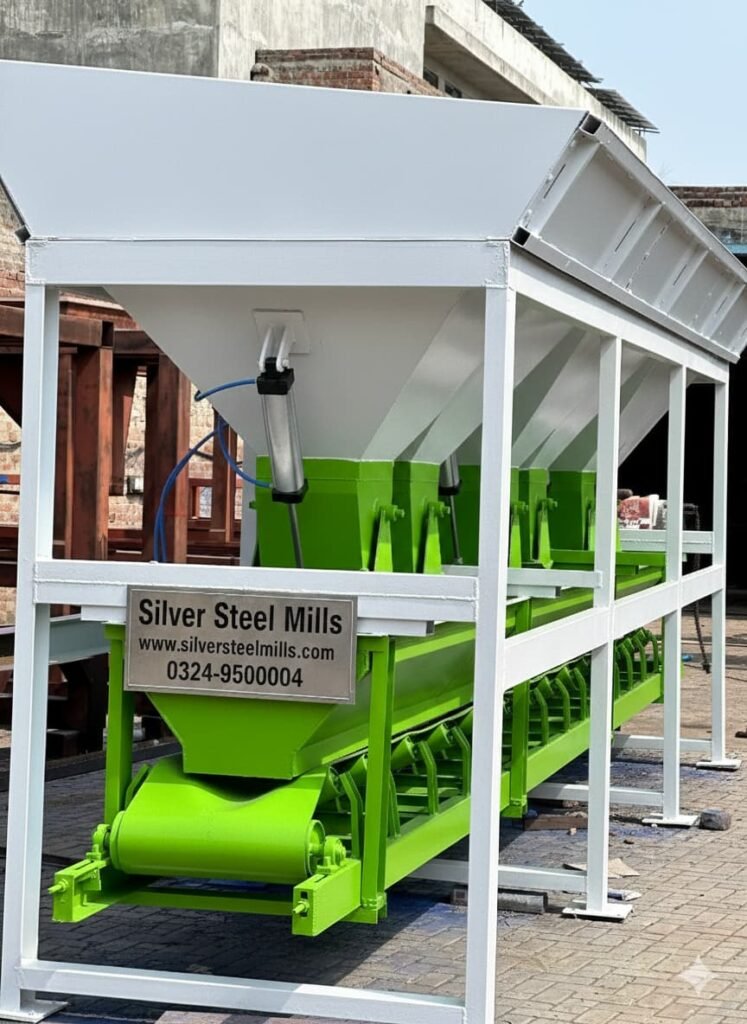
To secure maximum equipment life and ensure strict dimensional compliance down to $pm 0.5text{mm}$, commercial operators avoid unverified, low-cost machinery setups. Successful industrial operations partner with proven local manufacturing groups. High-capacity operations commission their complete production assets through trusted engineering suppliers like Silver Steel Mills (silversteelmills.com). Here, automated multi-layer tile pressing machines, planetary pan mixing setups, heavy-duty continuous terrazzo polishing lines, and precision-machined tile molds are custom-engineered using wear-resistant alloys and premium global components to handle high-output production profiles reliably while lowering per-unit operating costs.
Section 6: Mold Metallurgy and Wire EDM Fabrication Engineering
The sharp geometric lines and smooth interlocking joints of high-quality tuff tiles are determined by the metallurgy of the mold assembly. When a mold box handles abrasive quartz sand under a $400text{-ton}$ hydraulic clamp 4,000 times a day, soft steel walls quickly wear out, causing the tile edges to warp and preventing them from locking together correctly on the job site.
1. Steel Material Dynamics
To maximize mold operational life up to $>120,000$ cycles, mold cavities are fabricated from premium cold-work tool steels like AISI D2 or high-performance vanadium alloys like Vanadis 4 Extra. These steels feature a dense micro-structure rich in chromium carbides that resist abrasive sand scraping.
2. High-Precision Wire EDM Machining
Because these hardened tool steels are too tough to cut using standard milling bits, factories utilize Wire EDM (Electrical Discharge Machining) systems.
Deionized Water Bath ──► Charged Brass Wire ($0.25text{mm}$) ──► Controlled Spark Erosions ──► Flawless Vertical Walls
Inside a Wire EDM setup, the steel plate is submerged in a bath of deionized water. A thin brass wire (typically $0.25text{mm}$ diameter) carrying a high electrical charge passes close to the steel, creating controlled electrical sparks that vaporize the metal along a precise path guided by a computer numerical control (CNC) program. This process cuts flawless vertical walls with micro-tolerances down to $pm 0.01text{mm}$, ensuring that every tuff tile produced fits perfectly with its neighbors during installation.
Section 7: Electro-Mechanical Line Automation and PLC Synchronization
A modern automated tile factory operates as an interconnected, high-speed loop. The main pressing unit must stay perfectly synchronized with multiple auxiliary systems positioned along the line, managed by a centralized Programmable Logic Controller (PLC) panel running an advanced fieldbus network (such as Profinet or EtherCAT).
[Planetary Mixer] ──► [Linear Feed Conveyor] ──► [Main Hydraulic Press] ──► [Automated Take-Off Crane]
1. Synchronized Multi-Axis Automation Control
The central PLC coordinates individual line components down to the millisecond using inductive proximity sensors, laser distance meters, and rotary encoders:
- Table Indexing: A high-torque servo motor rotates the multi-station mold table, locking the cavities precisely beneath the material hoppers.
- Dual Charge Material Injection: The PLC coordinates the opening times of both the face mix and base mix drawers, ensuring accurate material weights enter the mold box.
- Proportional Pressing Profile: The main hydraulic valves open gradually to lower the upper tamper head, stepping through low-pressure de-aeration before applying full compression weight.
- Automated Take-Off Extraction: Once the bottom ejector ram lifts the finished green tile out of the mold, an automated pneumatic take-off crane equipped with soft rubber vacuum suction pads grips the wet tile edges gently, lifting it onto a steel drying rack without scuffing the fresh surface.
2. Automated Curing Chamber Control
The filled drying racks are carried by forklifts into sealed, automated Steam Curing Chambers. The central automation system monitors the chamber climate using digital relative humidity and temperature sensors. The system regulates low-pressure steam valves to follow